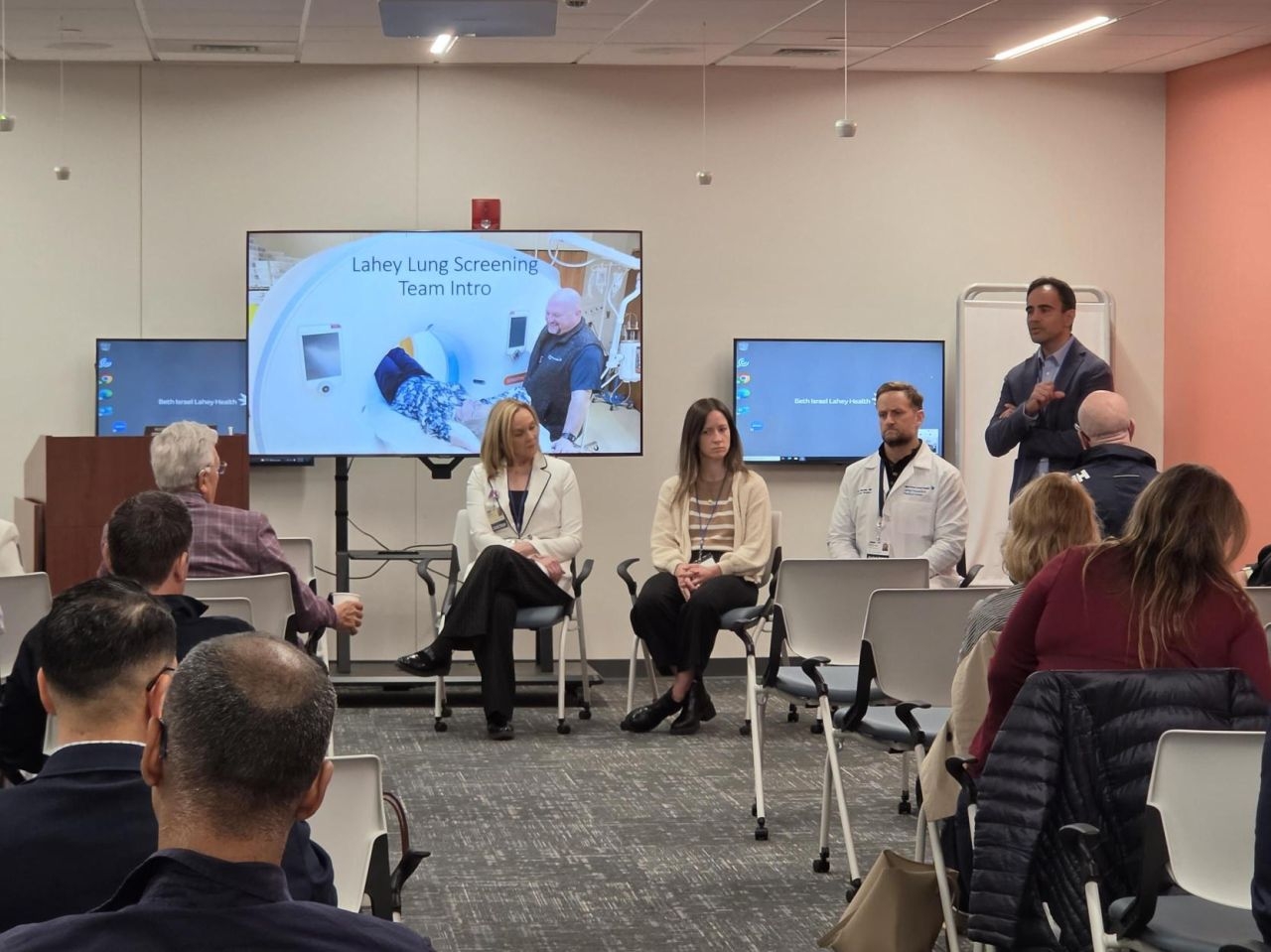
On Friday, May 1, the Lahey Clinic Innovation Hub brought together clinicians, technologists, researchers, and patient advocates for a first-of-its-kind event at its Burlington campus. The inaugural Care-AI-Thon, titled The Air We Breathe, marked a bold step forward in the effort to close one of oncology's most persistent equity gaps: the dramatic disparity between lung and breast cancer screening rates.
While breast cancer screening reaches roughly 72% of eligible patients, lung cancer screening lags far behind at approximately 6% — a gap driven by awareness barriers, limited infrastructure, stigma, and the challenge of reaching underserved communities. The event was designed not merely to surface ideas, but to produce actionable solutions grounded in clinical reality.
A Different Kind of Innovation Event
Unlike traditional hackathons, the Care-AI-Thon followed a clinician-first format. Medical professionals opened the day by defining the problem on their own terms — sharing the real costs, risks, and timelines that any proposed solution would need to navigate. Participating teams were then challenged to reshape their proposals based on what they heard, ensuring that the technology being developed reflected the actual conditions of care rather than theoretical ideals.
The result was a room full of honest conversations and genuine collaboration. Teams did not arrive with polished pitch decks. They arrived with proposals, rebuilt them in real time alongside clinical experts, and left with solutions designed for the real world.
Two Tracks, One Mission
Participants competed across two focused challenge tracks.
Track A: Clinical Detection & Workflow This track took the hospital's lens — exploring how AI could analyze multi-modal imaging and clinical data to identify at-risk patients earlier, improve risk stratification, and reduce missed diagnoses within existing care workflows.
Track B: Patient Engagement & Experience This track centered on the patient's lens — examining how AI and community data could help reach underserved and hard-to-reach populations, lower the barriers that keep eligible patients from being screened, and ensure patients have a real voice in how AI shows up in their care.
A third challenge thread — the Pink & Pearl Challenge, developed in partnership with the Massachusetts Life Sciences Center — ran across both tracks, asking teams to think creatively about leveraging the existing success of breast cancer screening pathways to drive referrals into lung cancer screening.
Track A Teams:
RevealDx brought a computer-aided diagnostic software solution focused on improving nodule risk stratification at the point of radiology review. Their approach centered on generating a malignancy similarity index score for each detected lung nodule, giving care teams an additional, objective layer of risk information to prioritize follow-up and reduce both false positives and false negatives — without overhauling existing radiology workflows.
Qure.ai came to the event with an AI-driven imaging analysis platform designed to enhance clinical detection through chest imaging, with a focus on surfacing findings that may be invisible to the human eye and integrating seamlessly into existing diagnostic pipelines.
Track B Teams:
Northeastern University presented "BreatheWell" (internally developed as Project PEARL+), an end-to-end AI pipeline that extracted eligibility signals from unstructured patient records, applied established USPSTF and NCCN screening criteria, stratified patients by social determinants of health and behavioral signals, and automated personalized outreach via SMS and voice with built-in fallback support. The team notably rebuilt their core approach mid-event following direct clinical feedback — and won the AI Innovation Award.
UMass Chan Medical School proposed an AI-powered chatbot designed to collect detailed smoking history directly from patients and determine lung cancer screening eligibility in a way that reduces burden on clinical staff. Their solution addressed one of the most persistent upstream gaps: incomplete or inaccurate smoking history documentation in the EHR, which causes eligible patients to be missed before screening is ever offered.
Zappix brought an established patient engagement platform already deployed within the Lahey system, proposing to extend its omni-channel outreach capabilities — spanning voice, SMS, and email — into the lung screening pathway. Their approach deliberately combined AI-driven engagement prioritization, rule-based automation, and human navigator oversight, with a particular focus on reaching underserved populations and reducing no-show rates without requiring patients to download an app or navigate a portal.
Solutions Built for the Real World
Five teams participated in the event, representing startups, academic research institutions, and student innovators, each contributing distinct approaches to improving lung cancer screening and patient outcomes through responsible AI implementation.
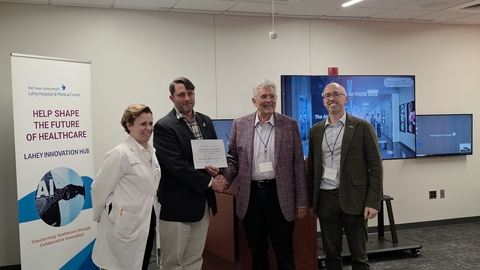
At the conclusion of the Care-AI-Thon, several awards were presented across both challenge tracks and innovation categories. In Track A, the Best Proposal (Most Ready for Clinical Integration) recognized the strongest solution for near-term deployment within clinical workflows. In Track B, the Best Proposal (Most Impactful Co-Design Roadmap) recognized the most compelling early-stage approach focused on patient-centered engagement and screening accessibility.
Additional Innovation Awards highlighted cross-cutting contributions to screening innovation. The Pink & Pearl Challenge Award recognized the most novel approach to improving screening navigation pathways between breast and lung cancer programs. An additional Innovation Award (Exceptional Clinical Insight or Patient-Centric Design) was presented to recognize outstanding emphasis on patient-centered design and clinical applicability in lung cancer screening workflows.
Across all submissions, teams explored diverse approaches spanning risk stratification, imaging analysis, patient engagement, and care navigation — reflecting the breadth of innovation the event was designed to inspire.
The Broader Vision
The Care-AI-Thon is the centerpiece of Lahey Innovation Hub's "Pearl" lung screening initiative, and the work does not end with the event. Selected teams will be eligible for pilot awards in the third quarter of 2026, with the goal of implementing solutions directly within the Lahey clinical environment.
The message from the day was clear: lung cancer screening is not simply a detection problem. It is an access problem, an equity problem, and an engagement problem. When AI is built into the reality of care — not layered on top of it — it has the potential to compress timelines, accelerate decisions, and shift outcomes in favor of the patient.
The inaugural Care-AI-Thon demonstrated that when the right people are in the right room from the first hour, meaningful healthcare innovation is not just possible. It happens.
A special thank you to our philanthropic supporters, the Massachusetts Life Sciences Center for their continued collaboration, and to all the guests who made this such a high-impact event.